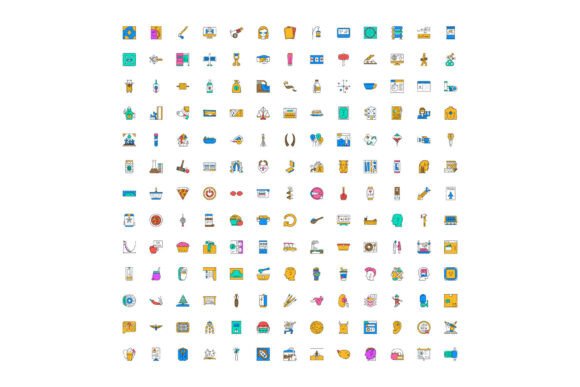
Exploring the Diverse Collection of Colorful Business and Large Colorful Grid of Flat Line Art Icons
In today's visually driven world, icons have become essential tools for communication, design, and storytelling. A diverse collection of colorful business and large colorful grid of flat line art icons represents a versatile and dynamic resource for designers, educators, marketers, and creatives across multiple industries. These icons are not just decorative elements—they serve as visual shorthand that can convey complex ideas quickly and effectively.
Whether you're working on an infographic, a website layout, or a mobile app interface, having access to a wide range of icons can significantly enhance your design work. This article explores the purpose, significance, and practical applications of such a collection, highlighting how it supports modern life, business, education, and creativity.
What Are Flat Line Art Icons?
Flat line art icons are minimalist illustrations that use simple lines and shapes to represent concepts, objects, or ideas. Unlike traditional icon styles that may include shading, gradients, or textures, flat line art relies on clean, two-dimensional forms to create clarity and visual appeal.
These icons are particularly popular in digital design because they are easy to scale, adapt, and integrate into various platforms. Their simplicity makes them ideal for use in infographics, user interfaces (UI), web design, and other visual media where readability is key.
The Benefits of a Diverse Icon Collection
A diverse collection of colorful business and large colorful grid of flat line art icons offers several advantages:
- Versatility: With icons spanning different categories like technology, food, travel, medical, education, nature, and lifestyle, these sets provide a broad range of options for any project.
- Consistency: A well-designed set ensures that all icons share a similar style, making them cohesive when used together in a design.
- Time-Saving: Instead of creating custom icons from scratch, designers can choose from pre-made sets, saving valuable time and effort.
- Visual Appeal: The use of color and line art adds vibrancy and energy to designs, making them more engaging for users.
How These Icons Fit Into Modern Life and Work
Icons are no longer just aesthetic choices—they play a crucial role in how we interact with technology, consume information, and navigate daily tasks. A large colorful grid of flat line art icons can be found in everything from smartphone apps to digital signage, helping users understand functions and concepts at a glance.
For example, in the technology sector, icons are used to represent features like cloud storage, data security, and mobile connectivity. In food and travel, icons can indicate restaurants, maps, or booking systems. In medical and education, they help simplify complex processes, such as patient care or learning modules.
These icons also support nature and lifestyle themes, making them ideal for environmental campaigns, wellness apps, or social media content. By using a consistent and colorful icon set, designers can create a unified visual language that resonates with audiences across different platforms.
Practical Applications in Design and Communication
The diverse collection of colorful business and large colorful grid of flat line art icons is particularly useful in the following areas:
- Infographics: Icons help break down complex data into digestible visuals, making information easier to understand and more engaging.
- User Interfaces (UI): In web and app design, icons improve usability by providing intuitive navigation and clear functionality.
- Marketing Materials: Whether in print or digital formats, icons add visual interest and reinforce brand messaging.
- Educational Tools: Teachers and instructional designers use icons to illustrate lessons, making learning more interactive and accessible.
Understanding the Significance of Color and Style
Color plays a vital role in how icons are perceived and interpreted. A colorful icon set can evoke emotions, highlight importance, and guide user attention. For instance, red might signal urgency, while green could indicate safety or growth.
Additionally, the flat line art style ensures that icons remain legible even at small sizes, which is critical for responsive design. This makes them suitable for both desktop and mobile environments, where screen space is limited.
Choosing the Right Icon Set for Your Needs
When selecting a versatile vector set of icons, consider the following factors:
- Category Relevance: Ensure the icons cover the topics most relevant to your project, whether it's business, technology, or lifestyle.
- Style Consistency: Choose a set that maintains a uniform look and feel, especially if you're using multiple icons in the same design.
- Scalability: Vector files allow icons to be resized without losing quality, making them ideal for different platforms and formats.
- License and Usage Rights: Verify that the icon set is available for commercial use and meets your legal requirements.
Common Misconceptions About Icon Design
Despite their widespread use, there are several common misunderstandings about icon design that are worth clarifying:
- Icons Are Just Decorative: While aesthetics matter, icons serve a functional purpose. They help users navigate, understand, and interact with digital and physical spaces.
- All Icons Are the Same: Different styles and approaches can significantly impact how icons are perceived. A flat line art style, for example, is distinct from a more detailed or illustrative approach.
- More Icons Mean Better Design: Quantity doesn't always equal quality. It's better to have a few well-chosen icons than an overwhelming number that lacks coherence.
Conclusion
A diverse collection of colorful business and large colorful grid of flat line art icons is more than just a design tool—it's a powerful resource that enhances communication, improves user experience, and supports creativity across industries. Whether you're a designer, educator, marketer, or developer, these icons offer a flexible and effective way to convey ideas, streamline workflows, and engage audiences.
By understanding the purpose, significance, and practical applications of such a collection, you can make informed decisions about how to best utilize these icons in your projects. As technology and design continue to evolve, the role of icons will only grow, making them an essential part of the modern creative landscape.