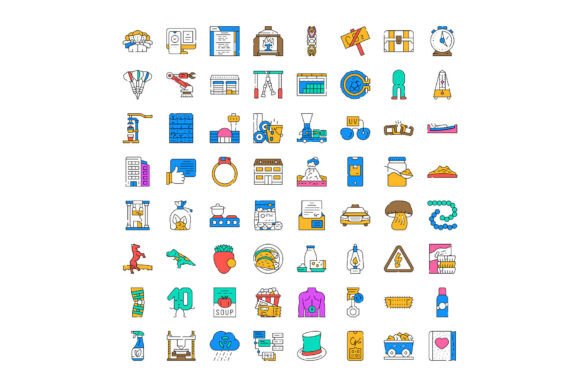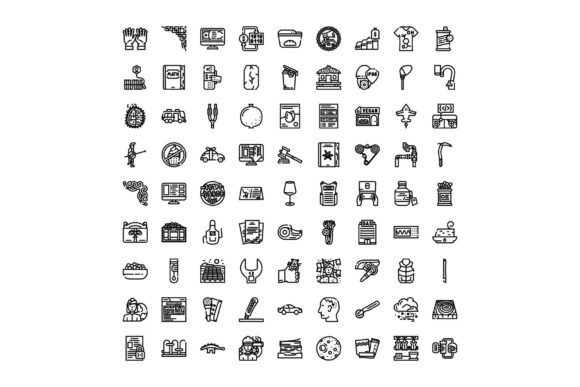
Collection of Diverse Line Icons for Var
A Collection of Diverse Line Icons for Var refers to a curated set of minimalist, outline-style line icons spanning multiple thematic categories—including business, technology, finance, travel, food, health, people, and general utility items. These icons are typically delivered in scalable vector formats (such as SVG), designed with consistent stroke weight, spacing, and visual rhythm to support cohesive interface design and data visualization.
Unlike monolithic icon libraries tied to specific frameworks or licensing models, this collection emphasizes breadth across domains while maintaining stylistic unity. It is intended for practical reuse—not as decorative assets, but as functional visual elements that clarify meaning, guide interaction, or support information hierarchy in web interfaces, dashboards, infographics, and documentation.
Why Consider This Collection?
Designers, developers, and content creators often face recurring challenges when selecting icons: balancing recognizability with stylistic consistency, ensuring accessibility across devices and contexts, and minimizing technical overhead. A Collection of Diverse Line Icons for Var addresses several of these needs directly.
First, its cross-domain scope reduces the need to source and harmonize icons from multiple providers—especially helpful when building applications or reports covering heterogeneous topics (e.g., a financial wellness platform integrating budgeting tools, nutrition tracking, and travel expense logging). Second, the line-based, minimalist aesthetic supports scalability and adaptability: icons remain legible at small sizes and respond predictably to color, weight, and contrast adjustments.
Third, because the collection prioritizes semantic clarity over novelty, individual icons follow widely recognized conventions—such as a briefcase for business, a heart for health, or a suitcase for travel—lowering cognitive load for users unfamiliar with the interface.
Key Benefits and Realistic Tradeoffs
The primary benefit lies in efficiency and coherence. When working on time-constrained projects—like launching an MVP dashboard or producing a quarterly report infographic—a unified set eliminates hours spent aligning stroke weights, adjusting proportions, or converting raster assets. Consistency also strengthens brand perception: users subconsciously associate visual uniformity with reliability and attention to detail.
However, tradeoffs exist. Minimalist line icons inherently sacrifice some contextual nuance. A single-line airplane may communicate “travel” effectively but cannot distinguish between commercial flights, cargo logistics, or private aviation without supporting text or layout cues. Similarly, abstract representations—such as a stylized brain for “cognitive health”—may require user testing to confirm interpretation aligns with intent.
Another consideration is customization depth. While SVG files allow for programmatic manipulation (e.g., changing stroke color via CSS), the collection does not include built-in variants (filled vs. outlined, animated states, or high-contrast versions). Users needing those features must implement them manually or supplement with additional tooling.
When This Collection Is a Strong Fit
A Collection of Diverse Line Icons for Var works well in scenarios where clarity, speed, and cross-category coverage outweigh the need for expressive detail or highly branded visuals. Examples include:
- Internal dashboards used by analysts or operations teams, where quick scanning and functional accuracy matter more than visual flair;
- Educational or informational websites presenting concepts across disciplines—such as a public health portal explaining links between nutrition, economics, and mobility;
- Responsive web applications requiring lightweight, resolution-independent assets that scale cleanly across mobile, tablet, and desktop;
- Infographics or data reports where icons serve as visual anchors alongside charts and statistics, reinforcing categories without competing for attention.
In each case, the collection supports a “less is more” approach: reducing visual noise while preserving functional meaning.
When Alternatives May Be More Appropriate
This collection is less suited for contexts demanding strong brand differentiation, emotional resonance, or domain-specific precision. For example:
- Consumer-facing mobile apps with distinct visual identities may benefit more from custom-drawn icons that reflect tone—playful, authoritative, or empathetic—rather than neutral line art;
- Medical or regulatory documentation might require icons validated against industry standards (e.g., ISO/IEC 11581 for healthcare symbols), where generic representations could risk misinterpretation;
- High-fidelity prototypes used in usability studies sometimes call for richer visual cues—such as subtle shadows, color-coded states, or micro-interactions—that go beyond static line icons.
Additionally, teams already invested in established icon systems—like Material Icons, Font Awesome, or custom design tokens—may find integration easier than migrating to a new set, especially if their workflow depends on icon fonts or automated build pipelines.
Practical Decision-Making Guidance
To determine whether a Collection of Diverse Line Icons for Var aligns with your goals, begin by auditing your current or planned use cases. Ask:
- What categories of concepts do you represent most frequently? If your content regularly spans five or more domains listed (e.g., finance + health + people + technology + travel), the collection’s breadth becomes a tangible advantage.
- How critical is pixel-perfect consistency across icon sets? If mismatched stroke weights or inconsistent alignment currently cause friction in your design handoff or developer implementation, a unified collection can streamline collaboration.
- Do your users rely on icons alone to understand actions or status? If so, test a representative subset for recognition and comprehension—particularly for less universal concepts like “blockchain,” “meditation,” or “supply chain.” Supplement with labels where needed.
- What are your technical constraints? Confirm compatibility with your stack: SVG support in legacy browsers, bundling requirements for static sites, or accessibility expectations (e.g., proper
aria-labelusage in code implementations).
Also consider maintenance effort. Unlike cloud-hosted icon services that auto-update, locally hosted icon sets require manual version management. If your team lacks bandwidth for periodic updates or documentation, a smaller, more focused set—or a subscription-based alternative—may reduce long-term overhead.
Final Thoughts
A Collection of Diverse Line Icons for Var serves a specific, practical niche: enabling clear, consistent, and efficient visual communication across varied subject areas without introducing stylistic fragmentation. It is not a universal solution, nor does it replace thoughtful information design—but when matched to the right context, it removes avoidable friction from the design and development process.
Before adopting, evaluate not just what the collection contains, but how its constraints and strengths intersect with your project’s scope, audience needs, and technical reality. The most effective icon choice is rarely the most elaborate one—it’s the one that helps users act, understand, or navigate with minimal interruption.